Introduction
What is the Live Exploit Tracker
The Live Exploit Tracker allows you to interact with CrowdSec's Threat Intelligence data, specifically focusing on CVEs and the IPs that exploit them. This enables you to prioritize vulnerabilities based on real-world exploitation data and mitigate threats by integrating IOCs with your existing security infrastructure: firewalls, SIEM, SOAR etc.
What to expect
The Exploit Tracker API allows you to access different features:
- Prioritize : Get information related to specific CVE(s) as observed by the CrowdSec Network.
- Mitigate : Get CTI data and IPs actively exploiting a specific CVE(s).
Prioritize
For a CVE, get:
- General CVE information: Name, Title, Affected Components, CWEs, References, CVSS score, Presence of known public exploit etc.
- Number of IPs actively exploiting the vulnerability.
- CrowdSec Analysis: A human readable text covering the most important information about the vulnerability:
- Technical description of the vulnerability
- Relevant information about payload such as targeted URI
- Description of exploitation patterns, from targeted to large-scale opportunistic attacks
- CrowdSec Scores:
- CrowdSec Live Exploit Tracker Score:
- Exploitation Status:
- Timeline information:
- First and Last exploitation observed
- CVE Publication date, Detection rule Publication date, CISA KEV addition etc.
- List of general events related to the CVE and its exploitation status.
Mitigate
From a CVE, get related IPs for different usecases:
CTI Information
- List of IPs exploiting the vulnerability over a given period, with their associated information, from reputation to known classifications. Allows to differentiate legitimate scanning actors (ie. shodan etc.), well-known attackers and newly deployed infrastructures.
Blocklists
- Create integrations allowing blocklist consumption from various firewall vendors.
- Subscribe integrations to CVEs, effectively blocking suspicious and malicious IPs known to actively exploit the vulnerability.
Web interface
Prerequisites
To access the Exploit Tracker API, you need an API key. Please contact the CrowdSec team to obtain your API key if you haven't already.
Access
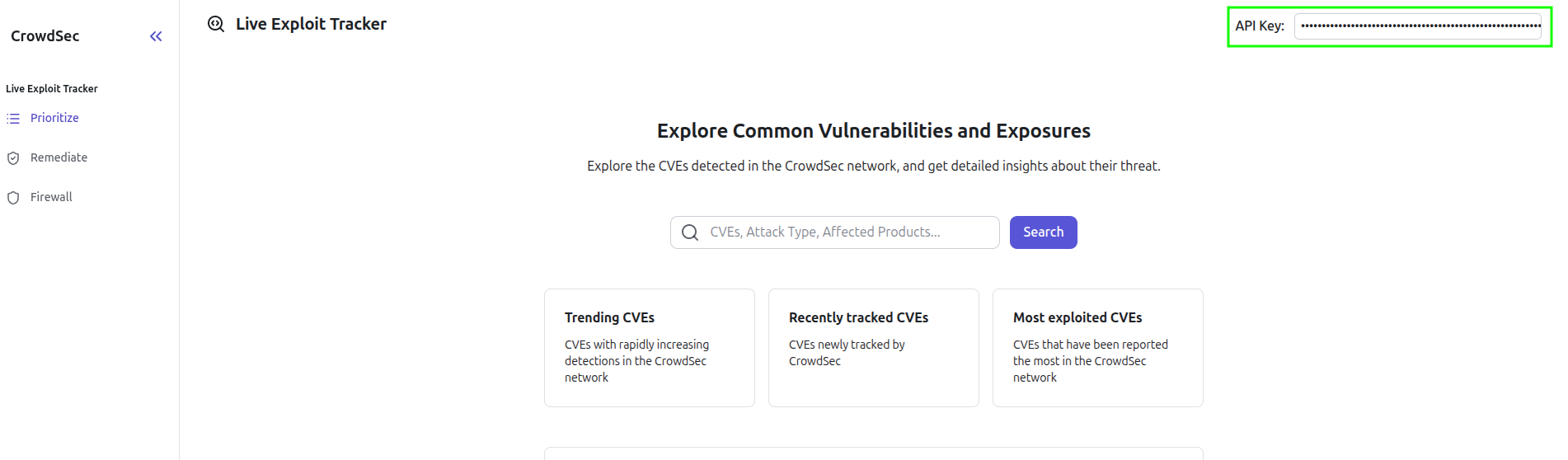
Connect to https://let.crowdsec.net and put your provided API key in the top right field.
API
Prerequisites
To access the Exploit Tracker API, you need an API key. Please contact the CrowdSec team to obtain your API key if you haven't already.
Authentication
To interact with the API, you need to configure the authentication using your API key.
import os
from crowdsec_tracker_api import ApiKeyAuth, Server

KEY = os.getenv("KEY")

# Configure Authentication
auth = ApiKeyAuth(api_key=KEY)

# Define the Server URL
base_url = Server.production_server.value
Quick Example: Get CVE Information
Here is a simple example of how to retrieve information about a specific CVE using the SDK.
- cURL
- Python
curl -i -H "x-api-key: ${KEY}" -X GET -H "Content-Type: application/json" \
https://admin.api.crowdsec.net/v1/cves/CVE-2024-25600
import os
from crowdsec_tracker_api import Cves, ApiKeyAuth, Server
from httpx import HTTPStatusError

KEY = os.getenv("KEY")

# Configure Authentication
auth = ApiKeyAuth(api_key=KEY)

# Initialize the Cves service
cves_service = Cves(auth=auth)

# Get CVE Details
cve_id = "CVE-2024-25600"
try:
    cve_details = cves_service.get_cve(cve_id)
    print(f"CVE: {cve_details.model_dump_json(indent=2)}")
except HTTPStatusError as e:
    print(f"An error occurred: {e.response.status_code} - {e.response.text}")
answer on success
{
  "cve_id": "CVE-2024-25600",
  "description": "Description of the CVE...",
  "severity": "High",
  "exploit_count": 42,
  "first_seen": "2024-01-15T12:34:56Z",
  "last_seen": "2024-06-10T08:22:33Z"
  ... other fields ...
}
Next Steps
Now you can:
- Explore the API Reference for detailed information on all available endpoints.
- Learn how to use Prioritize CVEs based on real-world exploitation
- Discover how to Mitigate Threats by integrating with your security appliances.
- Explore the SDK documentation on GitHub